martes, 20 de marzo de 2012

Ashton Eaton, next man Over 9000 points?


Ashton Eaton at the 2008 US Olympic trials
Photo: Matthew Stockman/ Getty Images North America
http://www.zimbio.com 
       
         In a championship where many of the most well-known track and field stars were absent, the World indoors in Istanbul provided however quite a lot exciting finals. Pushed by compatriot Janay DeLoach, Britney Reese produced an awesome 7.23, the best female leap in 8 years. Also at the jumping events ex-training partners Will Claye and world champion in Daegu Christian Taylor, the two men who are predestined to erase soon Jonathan Edwards from the book of records, offered to the spectators a new thrilling duel. Other impressive matches were seen at the shot put finals, where Valerie Adams claimed her title back against the fierce opposition of defending champion Nadzeya Ostapchuk and Ryan Whiting sensationally defeated surprising Daegu gold medallist David Storl, reaching for the first time the 22m barrier. As always happen in this kind of contest, some youngsters enjoyed the chance to shine and grab their first senior global titles: Mohamed Aman at the 800m, Genzebe Dibaba at the 1500m and Helen Obiri at the 3000m, the latter denying a fifth consecutive title to the great Meseret Defar. We witnessed also the extraordinary comeback to the top of two stunning Olympic champions, after a couple of disappointing seasons, Yelena Isinbayeva and Pamela Jelimo. Nevertheless the most remarkable feats at the world indoor championships in Istanbul were the world records achieved at the combined events in both sex categories by Nataliya Dobrynska and Ashton Eaton.  
            Since Christian Olsson and Tatyana Lebedeva did it in the triple jump at the 2004 edition in Budapest, we had not seen to break both male and female records in the same event at a world indoor championship.  Interestingly, the last time both pentathlon and heptathlon indoor records were beaten in a competition happened back in 1990, when French Odile Lesage and Christian Plaziat respectively achieved it in Nogent sur Oise. (1) The surprising result of Dobrynska adds still more emotion to the female combined events in the way to London. The Istanbul contest was expected to be a rematch between Jessica Ennis and Tatyana Chernova, after the latter upset the former at last world outdoor champs, but eventually the underdog got the better of both favourites. Ennis, who was widely seen as the most firm Briton candidate for a gold medal at the host Olympic Games prior to Daegu, has now additional mental pressure.      http://moti-athletics-hept-w.blogspot.com.es/2011/09/chernova-upsets-ennis.html   To broke the 20-year-old record of Irina Belova and the 5000-point barrier, the Ukrainian champion benefited of the outstanding quality of a competition in which were present 4 out of the 5 best in Daegu. Thus Jessica Ennis and Lithuanian Austra Skujyte also improved their respective national records and obtained the highest marks ever for a silver and bronze medal positions. (2) Not quite the same happened at the male contest, where Ashton Eaton got a 574 points gap over Ukrainian Kasyanov, who would have finished out of the medals in any other world indoor heptathlon final. The American athlete, who also achieved impressive PBs at the long jump (8.16) and shot put (14.56) and nearly matched it at the 1000m, had to compete on his own just the same he had done when he set his two previous world indoor records in Fayetteville and Tallin so there is a double merit in his feat. Ashton Eaton has accomplished an indoor world record three seasons in a row, raising it from 6476 to a 6645 total tally. Now the Oregon Track Club representative will try to translate his indoor superiority to an outdoor context, that is to say climb a step on the podium from his Daegu silver to gold in London, besides becoming the second man over 9000 points in a decathlon, to break Roman Sebrle's world best. Yet is he ready for the challenge? 

Ashton Eaton, the man who has set a world indoor record in three consecutive seasons
http://community.statesmanjournal.com/blogs/collegesports/2011/04/22/track-and-field-ducks-host-1700-athletes-in-two-day-oregon-relays/ 
                  Ashton Eaton, born in Bend, Oregon, the 21st January 1988, (3) was spotted at a high school meet by Dan Steele, the University of Oregon Associate Head coach. As the athlete recognises, he knew how to run and jump but, prior to his freshman season among the Ducks, he had neither intended to be involved in multi events nor had tried pole vaulting. However his progression was nothing less than spectacular. After only one year of practice with Steele, the responsible of sprints, hurdles, pole vault and combined events in Oregon, he won already the NCAA outdoor title in 2008. To this he would add in successive years two more victories outdoors and two indoors, an unprecedented feat in combined events in the Collegian track and field history, which earned him the prestigious Bowerman award in 2010. (4) Yet Ashton Eaton was not any athlete. Steele describes him like this: "He has got all the right physical tools. But I think the thing that makes him so amazing and so fun to watch is that he has got all the mental, emotional and intellectual tools as well. He has got virtually no ego. He has got an appropriate level of respect for the decathlon. He is humble yet confident. He is a tenacious competitor, yet he can handle losing." (5) Harry Marra, the decathlon national decathlon coach for 10 years who replaced Steele when he moved to Northern Iowa for the 2009-10 season, (6) also realised soon about the special man who was going to be his trainee: "For a guy 22 years old, his mental presence is remarkable." (7) Eaton is known as a cold-blooded, determined athlete, able to master every circumstance in a competition and always deliver his best. He has too an outstanding capacity for learning: even from watching his rivals performing he can quickly manage their technique to make adjustments in an actual competition.
Outsiders also point out how humble and approachable Ashton is, comparing his personality with great champion Roman Sebrle’s. (8) Furthermore he is the perfect track and field companion, someone who always privileges team interests over individual goals. Asked about his best memories in four years competing for Oregon University he did not talk about his five individual titles, world record or Bowerman distinction but about his performance in the 4x400 relay in his freshman year, which helped Oregon to win for the first time the male overall NCAA indoor title. He also had special good memories about just training with his mates. "I remember going up Hendricks Hill with all the guys and the girls, running 300s on the track, the type of things where you are with your teammates the most. When we win, it is awesome, but it is more about the whole process to get to that point. That is where the memories are. Right there." (7) Even at the NCAA championship in 2010, Eaton suggested Vin Lananna he could take four or five single events, instead of the decathlon in order to make points for the team. The Oregon head coach did not accept that sacrifice, only adding a long jump entry to Ashton’s expected presence in his pet event. No wonder such team-oriented and generous athlete has won the heart of another Oregon University multi eventer: Brianne Theisen. The Canadian-born athlete achieved along with her boyfriend a marvellous and never accomplished before swept of the combined events for their college at the 2009 NCAA champs in Fayetteville, repeating the feat the following year both indoors and out. Amazingly, as Eaton states, his girlfriend is not cold-blooded while competing like him but instead has an excited, fire-like behaviour on the track. Theisen, reappeared from injury this winter, has resumed her sensational NCAA curriculum in Nampa and is up for matching Ashton with a five title this summer, besides trying to become the third Canadian heptathlete with the A standard for the Olympic Games, along with Jessica Zelinca and Ruky Abdulai. This sensational success of Oregon multi eventers speaks plainly about the outstanding coaching in the area by Dan Steele first, then Harry Marra.     

Ashton Eaton in company of fiancée Brianne Theisen
http://www.rvgoddess.com/POSTCARDS/2010/Deja/MAY/051610.aspx 
Ashton Eaton competed at the US trials for Beijing Olympics, placing fifth with an 8122 tally, and qualified for the 2009 Berlin World championships, where he finished 18th. However his real breakthrough came at the 2010 NCAA indoor championship, when he broke the 17 year-old Dan O’Brien’s world record. His performance was still more amazing because Olympic champion Bryan Clay and World title holder Trey Hardee went on that same week end to win gold and silver respectively at the world indoor champs in Doha, scoring 300 points less than his young compatriot at the collegian contest. After a stunning victory at the national championships in 2011, with an 8729 huge PB, he went to Daegu as hot favourite of the competition. Living up to his role he slept as the overnight leader but in the second day he failed at the pole vault, clearing scarcely 4.60 and besides Trey Hardee and Cuban Leonel Suárez showed their superiority at the throwing events, displacing Eaton to the third place, before the 1500m. The five times NCAA champion then made an agonistic effort to regain at least the silver medal, which he got by only 4 points, after achieving his only PB of the championship, an astonish 4:18.94.  Trey Hardee successfully defended his title, thanks to his solidity in each one of the ten events. The winner, also a down-to-earth athlete and a superb teammate, encouraged Eaton, who had lost his confidence after his weak performance at the pole vault, and helped him to recover mentally and thus he could still win a medal. (9)  
Now the US decathletes have won every major championship of the last five years, thanks to Bryan Clay (Beijing Olympic Games and the 2008 and 2010 World indoor champs), Trey Hardee (Berlin and Daegu World championships) and Ashton Eaton (2012 World indoors). Therefore it is pertinent to raise the question about a possible sweep of the medals at London Olympics by that sensational trio for the USA. The last time this country accomplished that feat was back in the 1952 Helsinki Games, thanks to Bob Mathias, Milt Campbell and Floyd Simmons. This time around it seems very likely as well provided, as Hardee argues, they all three can stay healthy by the time of the Olympic Games. It was not the case in recent years for reigning Olympic champion Bryan Clay, who was unable to qualify for both Berlin and Daegu due to injuries. However in the 2010 season, when he could compete at his normal level he beat current number one Trey Hardee at the World indoor in Budapest and later won in the summer the classic Gotzis meeting, so he still has chances to defend his Olympic crown. The USA counts also with some brilliant upcoming athletes who can help to maintain further the country dominance in the event. At last year NCAA outdoor championship no less than 6 men (5 of them US athletes) scored 7900 points or more at the decathlon, including Michael Morrison, Miller Moss and Curtis Beach. The latter, who recently struck the indoor title in Nampa, has an incredible 3:59.13 PB at the 1500m and has run also the 1000m in 2:23.63 indoors when his NCAA triumph. And do not forget 19-year-old Gunnar Nixon, who set last January a brand new World Junior indoor record in a competition in Fayetteville. 
                     In the last couple of years the decathlon has been taken over by a new generation, not necessarily from the traditional countries in the discipline. Nobody in the Czech Republic has been able to replace for the moment Sebrle, Dvorak and Zmelik, and the former powerhouse of the discipline would have enough if Roman, the last survivor of that trio of champions, can assure the A standard for London. Nor much luckier are Germany and Russia. Some key names as Schrader, Muller and Abele in the former team, and Pogorelov, Sysoyev and Vasilyev in the latter, have not been able to perform at their best, because of struggling with injuries, and the officials have need to ask the help of very young athletes as Rico Freimuth and Jan Felix Knobel, both representing Germany in Daegu, and Artem Lukyanenko and Ilya Shkurenyov, third and fourth for Russia in Istanbul. At the 2009 Berlin World championships Trey Hardee with 25 years was the second oldest in the top-10 and something similar is likely to happen in London. Cuba was seen as the nation with the more chances to challenge the Americans with their young standouts Leonel Suárez, Yordanis García and Yunior Díaz. However, the latter has been sidelined by injuries, García has not progressed and Leonel Suárez, the most competitive of the trio when it matters, depend too much of his javelin skills. Then Belarus Andrei Krauchanka, the most talented of the new generation has not have a healthy season in the last three years and Oleksiy Kasyanov has been reduced to Mr Overnight Leader. Currently the men with more possibilities to shine in a near future are all of them born in the 1987, 1988 and 1989 years: Sintnicolaas, Freimuth, Knobel, Bouradaa, Dudas, Mikhan, Van der Plaetsen… All of them are excellent decathletes but with lack of enough experience to get to challenge the powerful US threesome for the medals at the upcoming Olympics. 


100m
LJ
SP
HJ
400m
110H
DT
PV
JT
1500m
PBs*
1
Roman Šebrle
CZE
 9026
Gotzis  27/05/2001
10.64
942
8.11
1089
15.33
810
2.12
915
47.79
919
13.92
985
47.92
827
4.80
849
70.16
892
4:22.00
798


PBs
10.64
942
8.11
1089
16.47
880
2.15
944
47.76
921
13.68
1016
49.46
859
5.20
972
71.18
907
4:21.98
798
 9328
3,3%
2
Tomáš Dvořák
CZE
 8994
ECp Praha  4/07/1999 
10.54
966
7.90
1035
16.78
899
2.04
840
48.08
905
13.73
1010
48.33
836
4.90
880
72.32
925
4:37.20
698


PBs
10.54
966
8.07
1079
16.88
906
2.09
887
47.56
931
13.61
1025
50.28
876
5.00
910
72.32
925
4:27.63
760
 9265
3,0%
3
Dan O'Brien
USA
 8891
Talence  5/09/1992
10.43
992
8.08
1081
16.69
894
2.07
868
48.51
885
13.98
977
48.56
840
5.00
910
62.58
777
4:42.10
667


PBs
10.23
1040
8.11
1089
16.69
894
2.20
992
46.53
982
13.47
1044
55.07
977
5.25
988
66.90
842
4:33.19
724
 9572
7,7%
4
Daley Thompson
GBR
 8847
Oly Los Angeles 9/08/1984
10.44
989
8.01
1063
15.72
834
2.03
831
46.97
960
14.33
932
46.56
799
5.00
910
65.24*
817
4:35.00
712


PBs
10.26
1032
8.11
1089
16.10
857
2.14
934
46.86
966
14.04
969
49.10
852
5.25
988
65.38*
819
4:20.3h
810
 9315
5,3%
5
Jürgen Hingsen
FRG
 8832
Mannheim  9/06/1984
10.70
929
7.76
1000
16.42
877
2.07
868
48.05
907
14.07
965
49.36
857
4.90
880
59.86*
736
4:19.75
813


PBs
10.70
929
8.04
1071
16.57
886
2.18
973
47.65
926
13.84
995
50.82
887
5.10
941
67.42*
850
4:12.3h
865
 9323
5,6%
6
Bryan Clay
USA
 8832
NC Eugene  30/06/2008
10.39
1001
7.39
908
15.17
800
2.08
878
48.41
889
13.75
1007
52.74
928
5.00
910
70.55
898
4:50.97
613


PBs
10.35
1011
8.06
1076
16.27
868
2.10
896
47.78
920
13.64
1022
55.87
993
5.15
957
72.00
920
4:38.93
687
 9350
5,9%
7
Erki Nool
EST
 8815
WCh Edmonton 7/08/2001
10.60
952
7.63
967
14.90
784
2.03
831
46.23
997
14.40
924
43.40
734
5.40
1035
67.01
844
4:29.58
747


PBs
10.34
1013
8.22
1117
15.11
796
2.05
850
46.23
997
14.37
927
45.28
773
5.60
1100
71.91
919
4:29.48
747
 9240
4,8%
8
Uwe Freimuth
GDR
 8792
Potsdam  21/07/1984
11.06
847
7.79
1007
16.30
870
2.03
831
48.43
888
14.66
891
46.58
799
5.15
957
72.42*
926
4:25.19
776


PBs
10.98
865
7.79
1007
16.42
877
2.15
944
48.17
901
14.54
906
51.54
903
5.15
957
73.02*
936
4:23.25
790
 9086
3,4%
9
Trey Hardee
USA
 8790
WCh Berlin  20/08/2009
10.45
987
7.83
1017
15.33
810
1.99
794
48.13
903
13.86
993
48.08
830
5.20
972
68.00
859
4:48.91
625


PBs
10.28
1028
7.88
1030
15.94
848
2.06
859
47.51
933
13.61
1025
52.68
926
5.30
1004
68.99
874
4:42.23
666
 9193
4,6%


13
Ashton Eaton
USA
 8729
NC Eugene  24/06/2011
10.33
1016
7.80
1010
14.14
737
2.05
850
46.35
991
13.52
1037
41.58
697
5.05
926
56.19
681
4:24.10
785


 8505
WCh Daegu  28/08/2011
10.46
985
7.46
925
14.44
755
2.02
822
46.99
959
13.85
994
46.17
791
4.60
790
55.17
665
4:18.94
819
PBs*


 8457
NCAA Eugene  11/06/2010
10.37
1006
7.90
1035
12.60
643
2.02
822
46.28
994
13.68
1016
41.71
699
4.70
819
54.07
649
4:21.85
799


PBs
10.19
1049
8.16
1102
14.74
774
2.11
906
46.28
994
13.35
1060
47.36
816
5.26
991
57.23
696
4:18.94
819
 9207
5,5%


And now comes the question about Ashton Eaton chances for an Olympic title in London and to break the existing outdoor world record. I had some fun making the table above, in which I compare the decathlon PB of each men who makes the all-time top-10 (including Ashton Eaton, who is actually 13th but is likely to improve on its place soon), with the total amount of his separate PBs in each one of the 10 events which form the decathlon. To create my table I used the IAAF website statistics along with Tilastopaja’s and the IAAF scoring table. (10) However, afterwards I realised on the site decathlon.com they already had an entry with a ranking of the 28th best scorers based in their separate PBs (11), so I used it too.

Dan O’Brien, despite being only third in the all-time decathlon ranking, clearly wins in the extra-official lists for a total tally of 9572, that is to say 681 points more (7.7%) than his PB from the 1992 Talence Decastar, which was at the time a world record, and 748 points over the score which earned him a gold medal at Atlanta Olympic Games. This enormous waste may be explained because of the superiority of O’Brien over every one of the decathletes of his generation and the subsequent lack of serious challenge. The previous number one of the event Daley Thompson was a man who excelled in every running event from the 100m to the 1500m. He was not as stunning at the throw circle but his ability to perform near his best at major championships allowed him to beat fine German contenders from both sides of Berlin Wall as Jurgen Hingsen, Siegfried Wentz, Uwe Freimuth or Guido Kratchsmer, which marks matched the British’s but were not as solid when it mattered most. On the other hand, O’Brien was as good as Daley at running and jumping events, with the exception of the 1500m, and besides was a much more accomplished thrower. Arguably the most talented decathlete ever, O’Brien had no worries about the world record, because he quickly improved it in 1992 and remained invincible for years, not even needing to do his 100%, except when he beat himself at the national trials for Barcelona Olympics, not making any valid jump at the pole vault. After O’Brien’s retirement, the next champions were not maybe as talented as he was but were instead rather effective in a moment every point was necessary because of the quality and quantity of the contenders: Zmelik, Dvorak, Sebrle, Nool, Macey, Huffins… That generation based its success in its consistency in every one of the 10 events of the decathlon, especially at the big occasions. Tomas Dvorak only lost 271 points (3.0%) in comparison to his separate best when he set his PB at the 1999 European Cup and Roman Sebrle missed 302 points (3.3%) when he set the current world record in 2001 in Gotzis. At global championships they also lead the ranking of efficiency: Dvorak scored 8902 points (4.1%) at the 2001 World Champs in Edmonton to beat Erki Nool’s 8815 tally (4.8%) and Sebrle set in Athens the current Olympic record with 8893 points (4.9%) to defeat Bryan Clay, who achieved the best not winning mark ever (8820). Both results bettered the performance of someone like Daley Thompson when he broke the world record in Los Angeles Olympic Games (5.3%).             

The last champions from the USA, Bryan Clay and Trey Hardee can be considered heirs of both the likes of Sebrle and Dvorak and also of national hero Dan O’Brien (even their only weak event is also the closing 1500m, a fact which is becoming a North American trademark). It is worth to say Hardee’s 8790 tally at Berlin Worlds (4,6%), ranks now in second place as the most efficient performance ever in a major championship, only inferior to Dvorak’s in Edmonton. However, Ashton Eaton has changed the trend. The new star of the combined events is not equally consistent in each one of the decathlon disciplines like Sebrle or Clay, but instead he is far more successful running and jumping than throwing just like old-legend Daley Thompson. Eaton has the same wide range on the track and precisely broke last year at the national trials the unofficial Briton’s record from 1986 for the highest amount of points achieved in a competition for the four events which make the group of running specialties. (12) The Oregon Track Club athlete has run the 100m in a world class, though windy, 10.19; the 110m hurdles in 13.35sec, a time no decathlete has ever run in a multi-events competition; the 400m in 46.28; and the 1500m in 4:18.94. None of the best combined event specialist in history can match that. Nevertheless the problem is Eaton is also the weakest thrower among the all-time top-10. It is true he has steadily improved in the last three seasons but still he is 242 points below in shot put- discus- javelin against someone not really special at it like Daley Thompson and he conceded a 326 points handicap to Hardee in Daegu, in a competition Ashton was close to his best in all three throwing events. 
                      In nowadays decathlon the decisive discipline is being precisely the javelin. Sebrle won the gold medal in Osaka ahead of Maurice Smith thanks to deliver in the right moment a 71.18 PB; Leonel Suárez who has a monster 77.47 PB at the event has accomplished a medal at the last three major championships only thanks to his javelin skills; finally Tatyana Chernova threw the implement 13m further than Jessica Ennis for an upset victory in Daegu. With 57.23m at the javelin at his best, along 47.36m at the discus and 14.74 at the shot put, the decathlete from Oregon can not expect neither to win in a major outdoor championship nor break the world record, unless he produces a Jackie Joyner-like groundbreaking performance at the running events and long jump or he follows the example of Carolina Kluft or Nataliya Dobryinska in their best days who are able to set a PB in half of the events in the most decisive championship. However, for the moment Eaton is more likely to fall short like Jessica Ennis in Daegu and Istanbul due to his current limits. It is true Ashton Eaton only started practising throws and pole vault a couple of years ago and still has plenty of room to improve. Besides he is an outstanding competitor and as an example he achieved a PB at the javelin with every one of his valid throws in his first serious combined event competition. He also should make a better display at the running disciplines than he did in Daegu, where he paid being a rookie in a major international contest. Hopefully, the best Ashton Eaton is yet to come and we will have to wait a couple of seasons to witness a mature and increasingly solid athlete breaking the limits of the decathlon and accomplishing sensational victories at Olympic Games and World championships.               

Ashton Eaton and Trey Hardee at the 2011 World Championships in Daegu
Photo: AP/ Lee Jin-man
http://www.kitsapsun.com/photos/2011/aug/29/229407/ 


domingo, 18 de marzo de 2012

Liu Xiang on the right Way to London, leaving Injuries behind

Liu Xiang became in Athens-2004 the first male Chinese Olympic champion in athletics ever
Photo: Donald Miralle/ Getty Images
http://www.the2012londonolympics.com/forum/beijing-2008-olympic-games-news/1991-fatigued-liu-xiang-save-energy-2008-olympic-games.html 
           How does it feel to be a national hero? And how does it feel when an untimely injury causes you to descend sharply from the skies to the ground, destroying your dreams of glory and so the expectations of millions of people? Track and field is a truly demanding sport and tough workouts derive in bothersome injuries. There is not arguably any other sport in which so many standouts are left out of important championships due to hamstring, knee or foot troubles. It was sad to see a half-fitted Mizuki Noguchi, trying bravely at Nagoya Marathon to qualify for London. The Olympic champion eight years ago could only run two marathons since, being unable to defend her title in Beijing. Yet she was largely seen heading the field in Nagoya and, after having been dropped early on, she did not give up, struggling for more than 10 km until she caught the leading group again, to eventually lose for the first time in her career against domestic competition. Noguchi was just another true champion beat up for a cruel fate. However, she is not the only one world or Olympic winner who risks ending up out of London Olympic Games. Tyson Gay, the last man who got the better of foremost track and field star Usain Bolt, is uncertain to be able of challenging him again this summer. One nation, Australia, has up to three athletes in the same situation. Nathan Deakes, 50km walk champion in Osaka in 2007, was back in Daegu. He tried to match former prowess just to discover he is not yet back to the fitness of his winning days and had to withdraw in tears. In London he will have another chance. Also another gold medallist in Osaka, Jana Pitmann, is running out of time to make the Olympic A standard, after a number of brief comebacks and new setbacks in the last couple of seasons. The Aussie hurdler seems to be doomed at the Olympics. It is likely to be the third straight time she is not ready for the most important of all athletic competitions. Finally, the great pole vaulter Steve Hooker will have to overcome his disappointing performance in Daegu. In Berlin Worlds, knowing his soaring groin would not allow him more than two or three attempts, he entered the contest at 5.85m and still got a marvellous victory. In Korea he could not match that feat, not making any valid jump at the qualifying round. Now there are too many doubts about his ability to match, in a near future, rising athletes as Renaud Lavillenie and Pawel Wojciechowski. Hooker’s Beijing Olympic champion counterparts at the horizontal jumps Irving Saladino and Nelson Evora are not much luckier than him. The former is having some lacklustre years, after a series of injuries, while the latter knows already he would not be able to defend in London. Finally, both double reigning Olympic champions from Ethiopia Kenenisa Bekele and Tirunesh Dibaba are struggling all over the last couple of seasons to regain their past form. Meanwhile, Kenya has taken the spotlight as the dominating nation in long distance on the track.   
            Not only veteran champions but quite a lot young hopefuls likewise have been sidelined recently. Bai Xue, the surprising winner at the World Championship marathon in Berlin, after two years with recurring injuries, made a desperate attempt to qualify for London at the Chinese national trials, and her effort was as unfruitful as Noguchi’s. Polish athletes Kamila Chudzik and Sylwester Bednarek were bronze medallists at 2009 World championships in Daegu at the heptathlon and high jump respectively but their promising careers came to a halt soon afterwards. Also teen prodigy Angelica Bengtsson is living a nightmare since last summer and, after not competing in Daegu, she was again unable to show up during the past indoor campaign. Now that Holly Bleasdale, Hanna Sheleh and Liz Parnov which she comfortably beat in junior and youth championships are making a big impression among the seniors, the leader of this talented generation must remain frustrated at home. And nor in much more optimistic mood can be her compatriot Susanna Kallur, who obtained a sensational world indoor record at the 60m hurdlers back in 2008 just to suffer a stress fracture soon afterwards, along with twin sister Jenny, who has already given up and retired from athletics. Sanna, a hurdler with a flawless technique who right now could be challenging Sally Pearson for the supremacy in the event, now and then announces her comeback to no avail. It is a truly unfair situation in which the athlete suffers in silence, unable to return to his past shape, now and then blamed for a weak performance by fans and journalists which are not always as sensitive as they should be, and when the time pass quickly forgotten. Does anybody remember promising Brit Becky Lyne, who was once labelled the succesor of Kelly Holmes? She is still trying to participate at the host Games. Becky says she used to be a conceited girl but injuries had taught her humbleness and what life really is. And at least she still can try: Petra Lammert, once the future of shot putting, had to retire from track and field and now is looking for a new dream in bobsleigh. Fortunately, there are also some athletes happily returned to the elite, after some difficult seasons. Ariane Friedrich underwent knee surgery last year and after the long break she has already jumped 1.91 this winter. It has also been marvellous how Ivet Lalova reached again a world championship final and dipped under 11sec, six years after she dramatically broke her leg in a competition warming up. During this period, she has needed seven different operations and no one could imagine one day she could be back to her best so these are really encouraging news.
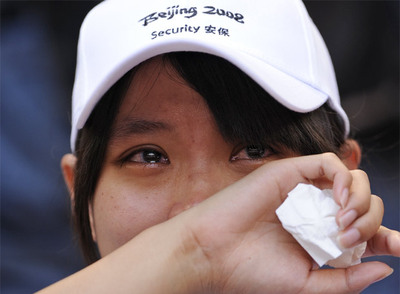
                 Nevertheless, maybe the most remarkable comeback, because of all he represents for a country of 1.3 billions of people, is the one of hurdler Liu Xiang. The man who became the first Asian athlete in winning an Olympic gold medal in sprints and also the first male Chinese in doing so in any track and field event at Athens 2004, had to endure four years later the bitter experience of letting down a crowd of 90.000 spectators and the dreams of a whole nation, when he exited the Bird Nest Olympic stadium, without even having the chance of competing.  
           
A volunteer is in tears after Liu Xiang withdrawal from Beijing Olympic Games
Photo: Associated Press
http://elpais.com/diario/2008/08/19/deportes/1219096806_850215.html 
                Liu Xiang, the son of a truck driver, entered sport as a high jumper but, in spite of winning the national championship of his age, a bone test showed (wrongly) he was not to be tall enough for the event so he was invited to give it up. (1) However, the kid from the Putuo district of Shanghai was determined to participate one day at the Olympic Games so he tried other specialties until renowned coach Sun Haiping, who had mentored Asian champion Chen Yanhao, spotted his talent for the hurdles in 1998. Famously, the young athlete’s parents wanted their son to concentrate in a College career as Computer Engineering instead of wasting his time in what they believed something without a future, so Sun had to make several visits to convince them. From then on, Liu Xiang’s progress over the hurdles was meteoric. After only three years practising the event he went on to break the world youth best, then the world junior record one year later in a meeting in Lausanne, with a clocking of 13.12 which stands to date. In his first senior season, Liu won a remarkable bronze medal at the World championships in Saint Denis and he followed it up with silver in Budapest in the winter of 2004, on occasion of the World indoors. Then came his sensational and unexpected victory at the Olympic Games over Terrence Trammell, defending champion Anier García and big favourite Allen Johnson, matching Colin Jackson’s world record time of 12.91 in the process.
            The gold medal Liu Xiang won in Athens was not really the first one in track and field for China in the history of the Olympics. Race walkers Chen Yueling and Wang Liping and long distance runner Wang Junxia had achieved it before. Even that same evening Huina Xing would also win at the women’s 10.000m, but Liu’s feat would have a much higher impact in the country than his female counterparts’. Soon the hurdler became a national icon, a role model, the most popular sportsman in China, along with NBA player Yao Ming. A part of the secret for sudden Liu Xiang’s success among his countrymen was he had accomplished an Olympic triumph in a speciality Asians had for long time thought to be genetically inferior to more muscled Europeans and Afro-Americans, who had dominated every previous Olympic 110m hurdles final. Liu himself had experienced that feeling in his first international competitions as a teen but soon realised his event is more about dynamics than pure speed and power. The new star of the high hurdles had not the explosive outburst of his iron-muscled contenders but his coordination and technique were outstanding, he rarely made a mistake, and his irresistible acceleration made him a fearsome contender for anybody. (2) After his surprising victory in Athens, legend Colin Jackson would react in awe, describing Liu as “a silky hurdler.” (3) This natural elegance and the fact for the first time an Asian sprinter was the reference for Europeans and Americans and not the opposite was quickly noticed by Chinese fans. “My victory has proved Asians can run fast too,” stated the proud new Olympic champion. (1)  
                          According to Wang Xiaoshan, a journalist of Sports Illustrated, Liu is on the frontline of a 30-year campaign to rebuild national confidence, based in investments in order to obtain sportive success. Since China was back to the Olympic Games in Los Angeles 84 its medal tally has been increasingly impressive. Traditionally the country was a powerhouse in tennis table, badminton, judo or gymnastics. Now they focused in some technical events as diving and shooting and then in other sports, until they eventually topped the medal table at the 2008 host Games with 51 gold and 100 medals overall.  "Until 1978 China was a closed country that thought it was doing well. Then we opened the door and suddenly realised we were poor and backward. It was a huge blow to national pride. To rebuild confidence, the government focused on sport. In the early Eighties the victory of the women's volleyball team in the world championship was a huge lift. Then we saw Chinese victories in many other events. But there was one area where it seemed we would never break through - men's athletics. Here we failed again and again until Liu came through and changed everything." (2) Thereafter China was something more than the land of ping pong and martial arts. They have shown the world they have the capacity to face the best even in track and field, the king of sports in the Olympic Games.
            Besides, Liu Xiang had something else: a special charisma and a personality which fits with the new image China wants to offer both internally and abroad. The Asian country has evolved from a closed country into an emerging economical powerhouse, which increasing presence all around the globe. Liu owns the qualities of hard work and sacrifice required for the collective building up of the Communist nation but at the same time represents the brilliant individualism the modern Chinese interests towards the world demand. (2) Liu has a taste for designer clothes, speaks confidently and smart, is rich, with a conquering smile, the perfect man to successfully sponsor Coca Cola, Nike and other international companies. And after all, Liu Xiang remains humble, still would like to live a normal life far away from the pressure of fame. He likes shopping, singing karaoke and chatting over the internet as any average Chinese citizen does. In the opinion of one of his most enthusiast fans "he has achieved the dream of every generation of Chinese athletes. Yet he remains very low-key, never shows off and does not talk about his personal life in public. He has made a deep impression on Chinese people's hearts." (3)  

Liu Xiang in pain, shortly before withdrawing from his 100m hurdles heat at Beijing Olympic Games
Photo: Adrian Dennis/ AFP/ Getty Images
http://www.theepochtimes.com/n2/sports/liu-xiang-withdrawal-premediated-3016.html  
             After his Olympic victory in 2004, Liu Xiang consolidated his number one status at the 110m hurdles with three other solid campaigns. In 2006 he broke his own world record, clocking 12.88 in Lausanne; then became world champion outdoors in Osaka and indoors in Valencia. Everything was set for the man who had become the image of modern China to make a breathtaking defence of his Olympic title at the host Games, raising once again pride in the country. Yet fatality made become the dream in a national tragedy. Emerging star Dayron Robles had taken Liu’s world record and the Cuban had clearly dominated during the summer season, while his Chinese archrival had competed scarcely due to a soaring foot. Robles appeared as the favourite but Liu was known to hold well the pressure and being at home he was expected to still prevail in a sensational clash.  Nevertheless, the whole China, who had been reunited in one heart as never before for the 110m hurdles Olympic final, had to witness in astonishment how their hero, unable to run his heat, exited by the back door. Liu Xiang’s recurring troubles with his right Achilles tendon had been kept in secret; only on the hurdler’s official webpage there was a mention of it and it was a real drama to watch Coach Sun Haiping trying to explain his trainee failure to compete, in a speech broke continuously by tears. Many fans and journalists showed sympathy with the athlete’s difficult situation (4) but others blamed him saying he had actually withdrawn beaten by the pressure and by his fear of Robles. (5) There was even talk Liu had been preoccupied all the time with sponsorship activities and advertising opportunities, thus having little time for intensive training so it was useless to run. (6)         

            Liu Xiang’s Achilles tendon required surgery, which was successfully undergone on December of that unfortunate Olympic year. Understandably, the depressed athlete also needed psychological help. Liu missed Berlin World Championships, not reappearing until late September of that year on occasion of the Shanghai Grand Prix. One month afterwards he took over the National Games for a record third straight time, in one of the most emotive victories of his career. However further complications on his foot only allowed him to compete in three races during the 2010 outdoor season. Yet, in spite of setbacks, he never lost the favour of his fans: 70.000 people were watching his victory in Guangzhou at the Asian Games. Eventually, the Chinese hurdler started to see the light last year, ending the campaign with a really praiseworthy silver medal at Daegu World championship, which could have been gold, had not old fellow Robles make him lost his balance with an irregular manoeuvre over the last obstacle. In 2012, we have witnessed the Chinese champion breaking again his indoor 60m hurdles area record and ending runner-up at the World indoors in Istanbul, after American Aries Merritt. Now, Liu is undergoing transcendental changes in his technique as reducing his number of starting steps before the first hurdle from eight to seven. While Yao Ming sadly retired last year after an injury plagued basket ball career, the other Chinese standout is on the right way to recover his lost Olympic title and number one status this summer in London. Curiously, now his rival and defending champion Dayron Robles is the one with injury concerns but hopefully he will be also ready to deliver the exciting match we missed four years ago. Good luck also for every injured athlete, wishing everybody will be healthy to attend the upcoming Olympic Games.  

Liu Xiang and Dayron Robles before their last clash at the Birmingham indoor meeting in February
http://www.runblogrun.com/ 


lunes, 27 de febrero de 2012

Ilke Wyludda now Aims for a Gold Medal at the Paralympic Games

Ilke Wyludda, the day she became Olympic champion
Photo: DPA
http://www.pnn.de/mediathek/608202/2/
                 London Olympic Games are just around the corner and every athlete is training hard to rise to the occasion. Usain Bolt would like to run the 200m under 19sec so his legend can continue growing and similar thoughts has Yelena Isinbayeva, who is happily back to her best with a new world record. On the other hand, Haile Gebrselassie, 20 years after his international breakthrough, suffered another setback in Tokyo on his aspirations to compete in his 5th Olympic Games but still do not throw the towel. In the female discus throw event, after some lacklustre years, there is a new generation helping to reinvigorate the discipline. Yanfeng Li will try to follow up her victory at Daegu Worlds with the Olympic title but Yarelis Barrios and young stars Sandra Perkovic and Nadine Muller are up for an upset, hoping to get the first 70-meter throw of this century. The latter has won in consistency in the last two years and thus targets to become the next number one athlete in the discipline coming from Germany, the discus throw powerhouse by excellence. No less than 6 women belonging to that country rank into the all-time top-10, which is entirely made up of performances from that controversial 1980s decade: Gabriele Reinsch, Ilke Wyludda, Diana Sachse-Gansky, Irina Meszynski, Gisela Beyer and Martina Opitz-Hellmann. A member of this illustrious club, Wyludda, was also the last German Olympic champion at the discus back in 1996. Now 42, she expects to compete at her 4th Olympiad but in very different circumstances to Bolt, Isinbayeva, Gebrselassie, Muller and her own previous appearances, after having her right leg amputated one year ago. 
                The Leipzig-born Wyludda was one of the most prodigious talents to ever step on an athletic throwing circle. She still owns the thirteen best junior performances at the discus, including a huge 74.40m from September 1988, which is, besides the existing world junior record, the fifth overall mark in the history of the event. She threw more than seven metres longer than any other junior athlete has ever done. Accordingly, Ilke was twice a World junior champion at her pet event and excelled also at the shot put, reaching 20.23, which ranks her only behind Astrid Kumbernuss and Heidi Krieger at the junior tables but ahead someone as 1980 Olympic champion Ilona Brisenick-Slupianek. Ilke was already representing the East German team, being 18, at the 1987 World Championships in Rome, where she finished just out of the medals. However, she was not named for Seoul Olympics with such competition inside of her own country. The more experienced Martina Hellmann, Diana Gansky and record holder Gabriele Reinsch made the trip to Korea. Martina, who once threw the implement beyond 78 metres in an unsanctioned meet, was back then the dominating force in the discipline. She clinched the gold medal at the Olympic Games, in the same way she had won it at Helsinki and Rome World Championships.
              Wyludda was biding her time, which would come in the following decade. The hopeful German never improved on her massive 74.56 from 1989 in Neubrandenburg but gained in consistency, thus winning her first international senior title at the 1990 European championships in Split. (1) She recorded 41 successive victories between 1989 and 1991 but surprisingly her streak came to an end at the world championships, where she was beaten by Bulgarian Tsvetanka Khristova. For the first time injuries would hinder her progression the following season so she had an unfortunate Olympic debut. Wyludda would need up to 15 times knee surgery but always had the willpower to continue on her athletic career. Even more than once she was on a wheelchair for months to come back stronger than ever. In 1994 she defended her European and World Cup titles and the next year she won again silver at the World Championships in Goteborg, behind Belarusian Ellina Zvereva. Then came her sensational victory at Atlanta Olympics, where she threw the implement to a masive 69.66 to get the better of Natalya Sadova and Zvereva. In successive years she would struggle with recurring injuries and eventually gave it up, after the impossibility of regaining her past fitness. In such technical discipline as the discus is, age is a bonus. Ilke Wyludda could still be competing by now. Actually some of her long time rivals as Zvereva, Dietzsch and Yatchenko only retired recently and Nicoleta Grasu, just two years younger, won the bronze medal at 2009 Berlin Worlds; but reality is sometimes tougher than you want to.      

Ilke Wyludda, training for the 2012 Paralympic Games
http://www.sport1.de/de/paralympics/artikel_505102.html
In December 2010 Ilke Wyludda was again in hospital but this time there were further complications. Her knee was infected by septicaemia and she had to choose between keeping either her leg or her life. After the amputation that miraculous back to fitness she had achieved so many times in the past was impossible. Yet Ilke did not fall in self-compassion and had the will of going on, in spite of the tragedy. “However much you cry you are not going to get your limb back. You cannot stand in the past but keep living with new aims, because life is a gift.” (2) Ilke studied medicine, with a doctoral thesis in pain therapy and now she is working as an anaesthetist at Bergmannstrot Hospital in Halle, the same place where she had her leg amputated. Being helpful to other people suffering the same kind of sad experiences, Ilke can find a motivation from now on. Her new situation brought her also to embrace track and field anew. The Olympic champion in Atlanta is a true fighter and she learned to be it through the practice of sport. (3) Now to be back in training contributes to maintain physical shape and also allows her to fight for a new dream: to grab another title at the Olympic Games, this time at the Paralympics category. Only Hungarian fencer Pal Szerkeres has won medals at both Olympics and Paralympics and Wyludda could become the first athlete in winning gold in both categories. (4)    
Ilke walks now with the help of prosthesis; her apartment and also her car had to be redesigned to fit the new needs of her daily life. She wakes up at 4:30 to reach hospital at 7:00, where she works full time. Then she trains five times a week. Gerhard Boettcher, who was her coach for 20 years has come back to guide her again, in spite he is now a pensioner. Wyludda states it is a new situation but she is already training at 80% of volume, compared to her past workouts. Last December, without any previous training she made her Paralympian debut in a competition in Dubai. She shot putted 6.20 and landed the discus to 20.69m. Not much to cheer about but she expects to improve to 9m and 30m respectively by the time of the Olympics. If she qualifies she will be competing there at the shot put (F 58 category), because the discus is not included in the program. Now she will not be targeting world records, becoming the best athlete in the world, yet her competition will be for life itself. Whatever she achieves in London, Ilke Wyludda is an inspiration for everybody about how to keep struggling for new dreams in life, despite fatality has struck you in the most dramatic way. 

Abebe Bikila was also an Olympic champion who had to endure the experience of
 a physical disability, after his dramatic car accident
http://www.elatleta.com/foro/showthread.php?115970-Fotos-atletismo-cl%C3%A1sico./page11 


jueves, 16 de febrero de 2012

Aldershot Girls: are London Olympics coming Too Soon?

      
Esther Chemutai and Charlotte Purdue running in foggy Antrim in 2011
Photo: Mark Shearman
http://www.iaaf.org/CROS11/news/newsid=59111.html
               Both Sebastian Coe and Steve Cram have complained lately British milers do not enjoy anymore competing through cross country trails during the winter season. In the 80s every distance runner used to do it, apart from the popularity of the speciality back then, as a basic preparation to gain in endurance and strength for his summer track campaign. For both legends of track and field this current lack of interest in cross country inside the UK is one of the secrets of the long crisis the nation is living in middle distance running. No current British athlete can be compared to Coe, Cram and Ovett; not even to Elliott, McKean or Williamson. Baddeley has fallen short of the expectations, Michael Rimmer is not consistent enough and Osagie is still on the making. Yet nowadays there are different times and even the World Cross Country championships are not going to be held this year for the first time since World War II. There is still the consolation of Mo Farah, who, by the way, was born in Somalia and whose amazing breakthrough came as he left the UK to join Alberto Salazar’s stable in Oregon. Still a British world champion at the 5000m, in a moment 80% of the kids of the country who are involved in track and field when they are 12 years old have given up the sport when they reach their twenties. Why keep it up if there is not a chance of getting close to the East Africans? Is it not the argument used by high school wonder in the USA Lukas Verzbikas when he decided to switch to triathlon? In Great Britain there is also now a never seen before passion for cycling, which has brought to the victory of Cavendish at the world championship.  
            But this is a man’s world. We have not thought about British female yet. And if there is no worthy heir in the country of past running legends among the men field, we can not say the same about the women’s. Not going very far away in time Jennifer Meadows won a bronze medal at the 800m at Berlin World Championships and Hannah England struck silver at the 1500m in Daegu. However role models are closer in time: Dame Kelly Holmes obtained her sensational double only two Olympic Games ago and Paula Radcliffe, whose world record in the marathon stands out of reach even for Kenyan and Ethiopian athletes, is still training hard to win at last a well-deserved Olympic medal, along with the younger generation. And, apart from some track and field drug addicts, has anybody really realised about the outstanding performances British teen girls are accomplishing in the last couple of seasons in Cross Country? Do not fear these youngsters the hardness of this kind of competition and the terrific East Africans? Listen to the words of the veteran of the group, three time European junior cross champion Stephanie Twell:  “Cross Country gives me strength of character because it is tough when you are racing in the mud, in the hills and in horrible weather. I think it gives you a sense of what being a real runner is all about; you are outdoors and you are facing adversities, both physical and mental. Plus the over-distance training you need for cross-country complements track events.” (1) It looks like these kids are really old-school in their approaching to athletics. And this revalorisation of Cross Country is common among her mates, even the youngest ones as Emelia Gorecka: “The course at Stanmer Park in Brighton was incredible! I can only describe it as a true cross country course – it had hills, mud, woodland, small paths and huge fields… a really enjoyable course to run on.” (2)    

Emelia Gorecka, the European junior champion
http://www.flickr.com/photos/adamkr/5501761119/sizes/l/in/photostream/

               Great Britain won all three female team titles at last European Cross country championship in Velenje and two of the individual races, thanks to Emma Pallant in under-23 category and Gorecka in juniors. It was just the continuation of a streak which started with the upset of a 16-year-old Steph Twell in 2006. Thanks to the Colchester girl, Charlotte Purdue and Emelia Gorecka, the Brits have grabbed five out of the last six junior titles, including a stunning sweep of the first six places in the 2008 edition, when Steph completed her hat trick. (3) Some of the United Kingdom Cross Country standouts are older as Hattie Dean, Freya Murray and Gemma Steel, who has been the senior leading Brit this winter, third in Velenje and second in Edinburgh and Antrim, only inferior among Europeans to the amazing Irish Fionnuala Britton, winner in all those three races. Nevertheless the most interesting athletes of the country are quite young and precocious runners: Twell won gold at the championships at 16; Purdue snatched bronze at 16, silver at 17 and eventually gold at 19; Gorecka, who had won 15 consecutive cross country races in 2008, obtained bronze two years afterwards at the European Champs, being 16 years old and gold at 17. Only Emma Pallant seems to be performing right within the parameters of her age.  Besides, Purdue became the youngest winner of the senior national trials in 20 years, and went on to cross the line at Punta Umbría World championship as the first European in place 14th. On the other hand, Gorecka, was the youngest contender at the junior race at the precedent edition in Bydgoszcz, finishing a creditable 23rd, which she improved to 15th in Punta Umbría. Twell, Purdue, Pallant and Gorecka belong all four of them to the same athletic club, Aldershot Farnham and District AC and train together under the supervision of acclaimed coach Mick Woods.
            Woods, a 63-year-old former marathoner from Ireland, has also an outstanding résumé. The mentor of the new generation of British female athletes has been coaching since 1986. Until 1993 he was also working as a full-time telecom engineer but decided to concentrate in his track and field profession once she got a job at St. Mary’s High Performance Centre at Twickenham University College, the main base of Aldershot club and the place where Charlotte is studying History. Mick Woods has coached at least one athlete in every World Championship since 1996. At the last one in Punta Umbría, 8 representatives out of 24 belonged to Aldershot. (4) Furthermore, three of his charges won in consecutive editions the British Rising Athlete of the Year award: Stephanie Twell in 2008, Charlotte Purdue in 2009 and Emelia Gorecka in 2010. Sprinter Jodie Williams eventually broke the streak in 2011, when no wonder Mick Woods was named Mentor of the year by the same prestigious magazine, Runner’s World. (5) 

Mick Woods and outstanding pupil Stephanie Twell
http://www.athleticsweekly.com/coaching/aldershots-waterloo/ 
             And what is the secret behind that stunning success of those young girls, of that single coach? Some has compared this athletic club with the one Kiyoshi Nakamura, the coach of Toshihiko Seko and Douglas Wakihurii, used to have. (6) It is a question of total loyalty, blind trust in Woods’ methods. Charlotte Purdue arrived to the club being 11, when she was spotted by Woods in a school race and Emma Pallant has been there as long as her mate. Steph Twell joined Aldershot even younger, when she was 9. The simple reason was she was living 600 metres from the track and her father was involved in the club. However nowadays she would never quit her coach. The prove is she was adamant in her decision of sticking with him in a moment it seemed St. Mary’s was going to be excluded from the high performance centres chosen to prepare British endurance athletes for London Olympics and she was asked to relocate to Loughborough with another coach. (7) Purdue and Pallant share her mate’s faith towards their lifelong trainer. Other athletes as Emelia Gorecka and Georgia Peel came later in their careers from other clubs but they are as enthusiastic about Aldershot. Gorecka states running is her relaxation time from studies, thanks to the extraordinary atmosphere created in training by her fellow athletes and Woods, which help her to stay at any time calmed and focused . Her Aldershot mates are also her best friends out of the track. (8) 
              Aldershot will never be a running elite-building factory. Mick Woods’s personality will never be up for that. For the successful coach the more pupils the better, especially when the sport drop rate is so high. And he does not necessarily recruit the most talented youngster. Purdue finished 16th at the race she was spotted by Mick, just at time because she did not expect to keep further her running career. "She was not an athlete with perfect movement. She had little leg lift and was very much a heel striker, but what I saw was someone who could have an engine - endurance - and that has always been Charlotte's success.” (5) What Woods praises in a trainee is commitment and perseverance, the willpower to keep going even in adverse circumstances, when results are not coming or injuries weaken confidence. In his privileged bunch there is no room for egos either. He places team over individual results, in a modus operandi similar to a pyramid, in which role models as Twell, Purdue (the top), inspire those around them (the base), creating the ethos inside the group. Then the target is to channel the base towards the top. (5) These amazing girls have also been a souce of inspiration for their male counterparts, who have raise their standards, as Jonathan Hay, stunning runner-up in the race of the Olympic champions last month in Edinburgh. Besides, working together, athletes with different skills or capacities support each other, as for example Emelia Gorecka contributes to Georgia Peel’s endurance improvement, benefiting at the same time from the superior speed of her mate. It helps engender the commitment and work ethic; this builds on the club’s success and, in turn, the athletes’ individual goals and performances.  

Georgia Peel, the trackster of the group... or maybe...?
http://www.prlog.org 

           There is always room for making friends and laughs but work have to be done. And it is quite tough. Mick Woods is someone who believes high volume is the base for subsequent quality work, as Lydiard or the same Nakamura. It is something many of the current coaches, who prefer shorter staff, have neglected, according to Woods’ opinion. And yes! Cross country in the winter is the best way to start the year. Even teen Georgia Peel whose longest event during the track season will be the 1500m, log the miles and competes happily through the mud, forest hills and the snow to acquire endurance and toughness for her summer races. And eventually, intensity is also required in training. If you want to be fast in championships you first need to be fast during your workouts. 
             In the last two winters some of the Aldershot standouts have also had the opportunity of training in altitude in Iten, Kenya, enjoying the facilities of Lornah Kiplagat’s training centre. One year ago, Twell and Pallant made the trip, along with other British athletes, and recently Steph repeated the experience with Charlie. Mick Woods could stay with them most of the time, getting fit following them riding a bike. (9) For natural runners like them it was an ambivalent journey. Emma was elated of her stage in Kenya and came back with positive feelings about everything from the food to the landscape. (10) Purdue was not as relaxed in Iten. She praised the work of the Kenyan staff at Lornah’s but the shower was “shit” and the gym was too crowded and noisy. Specially she did not get to adapt to the muddy and rocky trails and had to return home with a hurting knee. (11) Both expeditions were unlucky with climatic conditions. The first time it was too dry and too much dust was in the air. The second time the weather was unexpectedly rainy and it made difficult running. Anyway, injuries had been an obstacle too much frequently in the way of Mick Woods’ disciples, often as consequence of the highly demanding Aldershot’s workouts. Pallant faced retirement after a knee operation in 2009 and ongoing struggles in following seasons. Purdue did not race in six months in 2011 because of a stress fracture of the knee. Finally, Twell broke her ankle in five pieces in a Cross in Brussels one year ago and has been back only recently. The courageous athlete was prevented against running cross country again but she took the risk and achieved a praiseworthy fourth place in Velenje.          

             Fortunately all these amazing runners have currently left all their injuries behind and are training at full power for London Olympic Games. Yet it had been nice if their beloved specialty, Cross Country, would have been included in the Olympic programme. Lacking it, they will have to concentrate their efforts for the track. To date, the only Aldershot athlete whose performances on the stadium match the ones on the fields is Steph Twell, who won the final at the World Junior championships in 2008, in a race Emma Pallant struck bronze. (12) That victory over Kenyans and Ethiopians, notably over Kalkidan Gezahegne, current world indoor champion and 4th placer outdoors in Daegu, was a huge boost of confidence for Steph, who also made her Olympic debut in Beijing that same year. Afterwards she has improved her marks to 4:02.54 at the 1500m and 14:54.08 at the 5000m, alternating up and downs in major championships. In her reappearance year after a whole season cut down by her broken ankle, she is entering the turning point of her career. Almost 23 by the Games, she will have to prove herself she can now face anybody. It will be an excellent opportunity for her in an event quite open and besides cheered by her own public. Look at also for Emma Pallant, for years at the shadow of giants Twell and Purdue, who eventually won her first international title in Velenje and can be in the year of her breakthrough.
            Charlotte Purdue proved she was born for tough cross country challenges, ever since she sensationally endured extreme heat and humidity in Mombasa in 2007, to end up the first not-African in the junior contest at age 15.  Lately we have seen her also successfully mastering the roads, as at last Bupa Edinburgh Great Run, where only one of the best, Lucy Wangui, could beat her. Charlie has entered next New York City half-marathon and her future may well be at the longest of the Olympic events. Twell is on the way of becoming the new Kelly Holmes, while Purdue might be a worthy heir of Paula Radcliffe… but for Rio de Janeiro in four years time. Meanwhile, she would try to qualify for the 10.000m for London, but her far-from-economic style of running does not seem to fit the track. For another pure cross country runner, Emelia Gorecka, these Games come too soon but if Jordan Hasay has focused all her season for the Olympic US trials, why should not try such extraordinary youngster as Emelia. Her teen companion Georgia Peel, who like Pallant (13) attended the “On Camp with Kelly” mentoring project for promising middle distance runners, would like to give joy to Dame Holmes qualifying for the host Games at the 1500m. (14) Winner at her first international outing, the World School Games in Doha in 2009, where we also discovered Gorecka, Georgia suffered later two successive setbacks at the Youth Olympic Games and Youth World championships, returning home without a medal. (15) Now she will be up for revenge. Too much too soon, but when there is so much talent and athletic passion you never know.         
Emma Pallant at her training stage in altitude in Iten, Kenya, in February 2011
http://www.athleticsweekly.com/blog/starting-2011-up-high/